
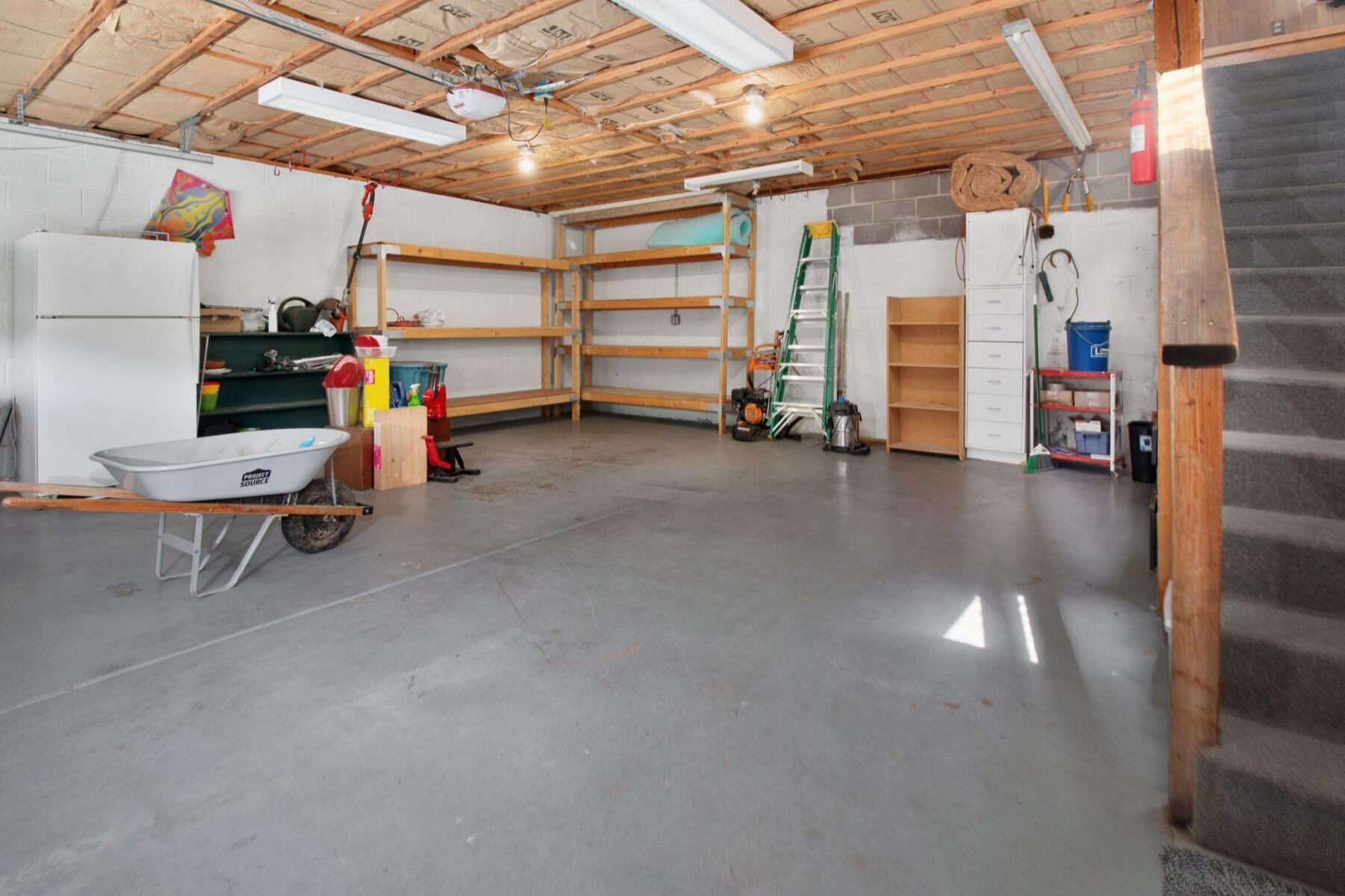
If you're looking at a can of garage floor paint and wondering whether it will hold up, the short answer is yes. You can paint a concrete garage floor, and for a dry, sound slab with light use, paint can be a reasonable choice. Whether it lasts comes down to three things the paint can itself warns about: the temperature when it goes on, moisture coming up through the slab, and how long you keep the car off it. In a Victoria garage, the first two are the ones to check carefully.
What is "garage floor paint", exactly?
The cans on the shelf are one-part products, so you open them, stir and roll. Rust-Oleum describes its EpoxyShield 1-Part Concrete Paint as "a modified acrylic floor paint" (Rust-Oleum Canada TDS). Behr's Concrete & Garage 1-Part Epoxy Coating lists its resin type as "Acrylic/Epoxy" (Behr Canada TDS). When a one-part label says "epoxy", it means an epoxy-modified paint. The two-part system that gets mixed and applied over a ground slab is a different product.
Either way, the film these paints leave is thin. Behr's sheet gives a dry film of 43 µm (1.7 mils) per coat at 300 sq ft per gallon, the heavier of the two rates it lists, and Rust-Oleum recommends 75 to 87.5 µm (3.0 to 3.5 mils) dry per coat. That's enough to add colour and make the floor easier to clean, but it's still a thin layer to park a car on.
Why do painted garage floors lift where the tires sit?
Both data sheets ask you to wait a long time before a car goes on the floor. Behr says to "allow 7 days before subjecting painted surface to automobile tires" and to wait 30 days before washing the floor. Rust-Oleum lists vehicle traffic at 7 days, measured at 21 to 27 °C and 50 % relative humidity. Behr is blunt about why: "Premature heavy traffic will cause paint failure requiring spot recoating." (Behr product sheet)
Even if you wait the full time, the makers expect some wear. Behr's sheet notes that "an annual touch-up may be required in areas subject to tire traffic", and Rust-Oleum says "occasional touch-up may be required in areas subject to heavy traffic." If you're fine touching up the tire lanes now and then, paint fits. If you'd rather stop thinking about the floor, skip ahead to the last section on coatings.
Is a Victoria winter too cold to paint a garage floor?
Often it is, if the garage is unheated. Behr wants air, material and surface temperatures between 10 °C and 32 °C, and warns that below 10 °C the paint may not form a proper film. Rust-Oleum's range is 15 to 29 °C, with the surface at least 3 °C above the dew point and relative humidity no higher than 85 %.
Environment and Climate Change Canada's 1981 to 2010 normals for Victoria International Airport put the January mean daily high at 7.6 °C and the mean daily low at 1.5 °C (ECCC climate normals, Victoria Int'l A). Those January averages sit below both paint ranges, so if your garage is unheated, check the slab temperature before you plan a midwinter paint job. The same normals show 143 mm of January precipitation over about 19 wet days, which means cars come in wet for much of the season. So the easier window for a one-part paint is the warmer, drier months, when air and slab temperatures are more likely to stay inside the ranges on the data sheets.
Two-part products have their own limits too. Sikafloor-530, a polyaspartic floor coating, lists a minimum of +8 °C (Sika PDS), so no product turns a cold, wet garage into a good place to work. The winter section on the garage floor epoxy page covers what that means for a coating.
What does slab moisture do to paint?
Both makers warn against painting a floor that has a moisture problem. Rust-Oleum's 1-Part sheet says the paint "is not intended for use on unsound previous coatings or floors that have a moisture problem," and Behr's sheet says not to use its product on "areas subject to hydrostatic pressure."
Rust-Oleum's EpoxyShield garage floor kit sheet describes a simple first check you can do yourself. Tape a 2 ft × 2 ft sheet of plastic to bare concrete and leave it for 24 hours, and if droplets form underneath or the concrete looks darker, "moisture is trapped in the concrete" (Rust-Oleum EpoxyShield TDS). A wet result is a clear sign not to paint. The garage floor moisture test guide explains the instrument tests that give an actual reading.
Can you paint over old paint or a sealer?
You can, as long as the old layer is still holding on. The same Rust-Oleum sheet gives a tape test: cut an X through the old coating down to the concrete, press duct tape over it and pull it off in one quick motion. "If more than 25% of the paint comes off," the sheet says not to coat until the old paint is completely removed, since new paint can only stick as well as whatever it sits on.
For bare concrete, both makers ask you to clean and etch first, and new concrete needs to cure before any paint goes on: 28 days on the Rust-Oleum sheet and 30 days on Behr's. Rust-Oleum's 1-Part sheet tells you to remove any oil spots, grease or spills before painting, and the EpoxyShield kit sheet says that if water beads on the floor, a sealer is present and "paint may not adhere properly." The guide to why garage floor coatings peel walks through those failure points in more detail.
Mid-post CTA: If your floor is already flaking or you're not sure what's on it, you can describe it in the form with your town, the rough size of the garage, and what the surface is doing now.
When is paint enough, and when is a coating the better choice?
Paint makes sense on a dry slab that passes the plastic test, in a garage you can keep warm while it goes on and cures. It also suits you if the car can stay out for a week and you don't mind touching up the tire lanes. It adds colour and makes the floor easier to clean, and the data sheets are honest that it needs upkeep.
A ground, multi-coat system fits better when the slab shows moisture, when old paint fails the tape test, when the floor sees daily parking or heavy use, or when you'd rather not be repainting. For the chemistry and cure differences between those systems, see epoxy vs polyaspartic, and the garage floor epoxy page covers how a Victoria slab is usually prepared for one. Cost depends on the size of the floor, its condition, how much old coating has to come off, and what the moisture reading shows, so any price for a coated floor starts with those details.
End CTA: Not sure whether your floor is a paint job or a coating job? Use the form to describe your garage, including the town, the rough size, what needs doing and what the surface is doing now.