
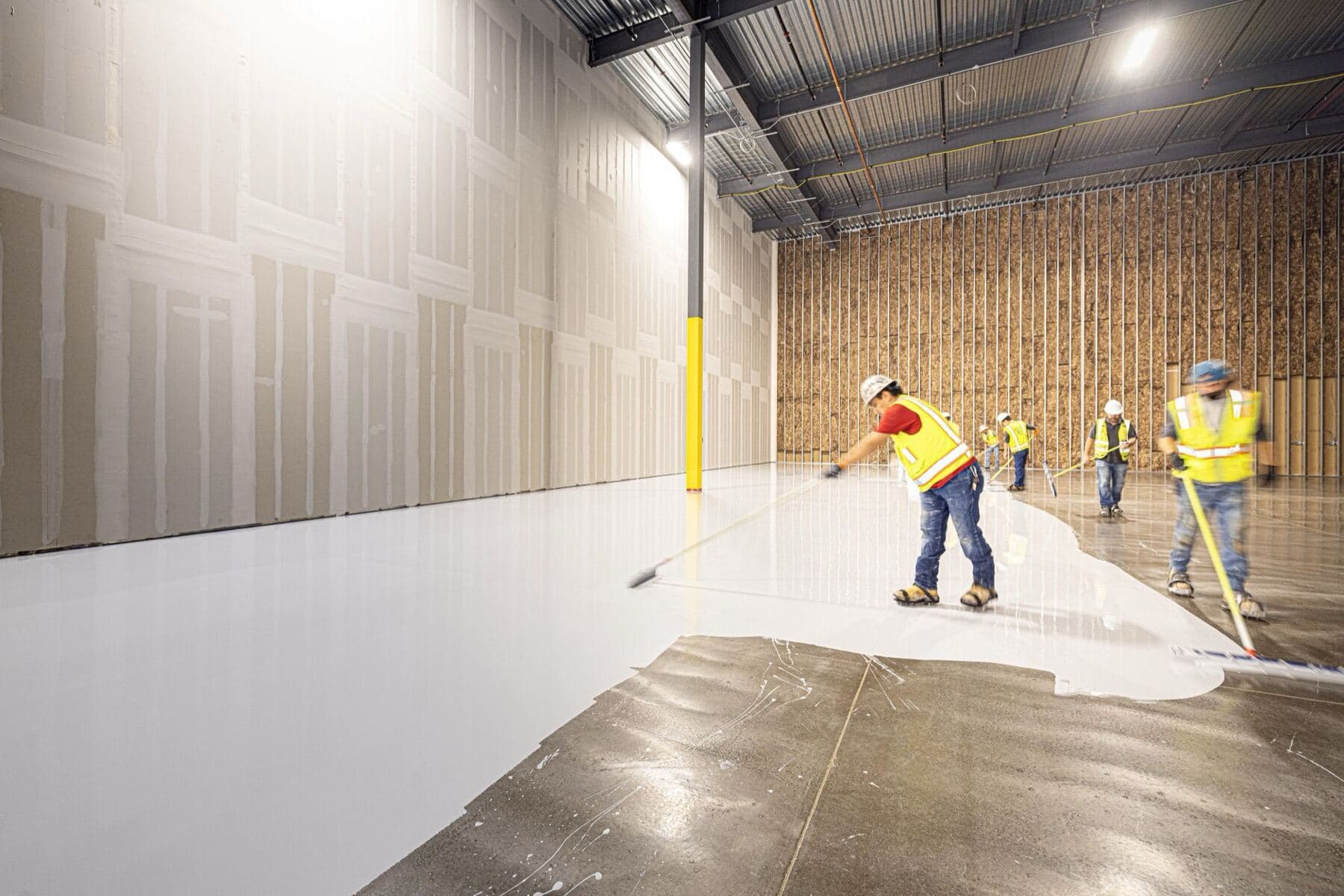
Protective coating in Sidney BC covers four products: a resin floor coating in a garage, a cementitious overlay on tired concrete, an asphalt sealer on a driveway, and traffic paint on a lot. All four bond to the surface you already own rather than replace it. All four are limited by the same thing on the Saanich Peninsula, and it is not the cold.
What counts as a protective coating on a Sidney property
The phrase describes a category, not a product, and the four systems inside it are doing different jobs. A garage floor coating is a resin system, usually a pigmented epoxy build coat under a polyaspartic wear layer, ground into the slab with a diamond grinder so it keys into open concrete. Concrete resurfacing is different chemistry: a cementitious overlay bonded over a slab that is structurally sound but worn, rebuilding the surface instead of sealing it. Driveway sealcoating is an asphalt emulsion that puts back the binder that ultraviolet light burns out of the top few millimetres of pavement. Line painting is traffic paint over prepared asphalt or concrete.
None of them is a repair. A coating follows the surface underneath it. If a slab is heaving, if a driveway is cracked through to the base, or if water is moving up through the concrete, a coating over the top buys a season and then telegraphs every fault it was hiding.
The weather the coating has to live in
Sidney has no weather station of its own publishing climate normals. The Environment and Climate Change Canada record for SIDNEY DEEP COVE runs from 1967 to 1973 and carries no normals. The nearest station that does publish a full set is Victoria International Airport, a few kilometres north on the same peninsula, which makes it a far better proxy for a Sidney driveway than any of the downtown Victoria stations. Everything below is that station, climate identifier 1018620, normals period 1981 to 2010.
| Month | Mean precipitation, millimetres | Mean 0600 LST relative humidity | Mean 1500 LST relative humidity |
|---|---|---|---|
| January | 143.24 | 89.08 | 78.15 |
| February | 89.29 | 87.73 | 70.12 |
| March | 78.43 | 86.67 | 65.96 |
| April | 47.90 | 85.46 | 60.27 |
| May | 37.53 | 83.20 | 59.47 |
| June | 30.57 | 80.55 | 57.46 |
| July | 17.87 | 82.41 | 55.86 |
| August | 23.82 | 86.69 | 56.68 |
| September | 31.12 | 89.52 | 59.96 |
| October | 88.12 | 89.83 | 69.30 |
| November | 152.59 | 89.52 | 77.35 |
| December | 142.46 | 88.41 | 79.39 |
| Year | 882.94 | 86.59 | 65.83 |
Assembled from Environment and Climate Change Canada climate normals for VICTORIA INT'L A, climate identifier 1018620, period 1981 to 2010: Total precipitation mm, Mean of 0600 LST relative humidity, Mean of 1500 LST relative humidity.
Humidity decides when work starts, not the season
A coating specification carries three separate moisture limits and only one of them is a temperature. Air and surface temperature have to clear the product minimum, typically 10 °C on a floor coating data sheet. Relative humidity has a ceiling: the maximum at which coatings or linings can be applied and cured is generally set at 85%, per DeFelsko's guide to measuring environmental conditions. And the surface has to stay clear of the dew point by a minimum of 5°F (3°C) through preparation, application and cure, a figure that comes out of ASTM D3276 and ISO 8502-4.
Line those three limits up against the table. Temperature is rarely the binding one. The same station records 261.81 days a year with a daily maximum above 10 degrees, so on most of the calendar the thermometer is fine. Humidity is the one that bites. The 0600 LST relative humidity normals sit above the 85 ceiling in nine of the twelve months and peak at 89.83 during October. A slab that starts the morning sitting on the dew point will not hold a coating no matter how pleasant the afternoon turns.
Which produces the thing worth knowing before anyone quotes you. On this peninsula the coating window is an afternoon window for most of the year rather than a summer window. The 1500 LST relative humidity normals clear the 85 ceiling in all twelve months and bottom out at 55.86 during July. A crew that opens a Sidney garage floor at eight in the morning in October is working against the data. One that grinds early, lets the slab come up with the day and coats after lunch is not. In an unheated garage, or on any slab that will not hold the dew point margin on its own, heat and dehumidification are what make a data sheet apply to your floor instead of to a laboratory.
What sea salt actually does, and what it does not
Marine air is the real difference between a Sidney driveway and one in Langford, and the mechanism is not the one most people assume.
Sea salt is deliquescent, meaning it pulls water vapour out of the air and turns into a liquid film. Sodium chloride does this at a deliquescence relative humidity, or DRH, of 74.3, and real sea salt, which carries magnesium and calcium chlorides alongside the sodium chloride, takes up water below that, according to work published in Nature Communications. Set that against a 6 a.m. relative humidity normal of 86.59 for the year. Salt landing on an exposed driveway or garage apron here is not a dry crust waiting to be swept off. Most mornings it is a wet film.
That matters at both ends of the job. Before the coating goes down, a salt film holds the surface damp when the air says it should be drying, so a moisture reading taken at the wrong hour flatters the slab. After the coating goes down, soluble salt trapped underneath pulls water through the film osmotically and lifts it in blisters. The industry check is the Bresle method, run with a conductivity probe rather than judged by eye, defined in ISO 8502-6 and 8502-9. On a coastal property the decontamination wash is load bearing, not housekeeping.
What salt is mostly not doing on a residential surface here is the thing the marine engineering literature describes. Chloride attack on reinforced concrete is a tidal and splash zone problem, and it is about steel corroding inside the slab. A Sidney garage floor or asphalt driveway is rarely in that fight. The failure you will actually meet is a coating that never bonded, which is a preparation problem with a preparation fix.
What a protective coating costs in BC, and what moves the number
No honest figure here is a quote, because the same 500 square feet can differ by thousands on preparation alone. Published market data is still worth carrying into the conversation. For resin floors, the HomeStars price guide for epoxy flooring in Canada puts the average at $3 to $12 per square foot and splits the material by resin type: $2 to $5 waterborne, $4 to $7 for 100% solids, $5 to $8 for a UV-resistant system. On the asphalt side, the same publisher's driveway sealing price guide puts Canadian resealing at $0.15 to $0.45 per square foot. Both are national figures describing a market, not Vancouver Island figures and not anybody's bid.
What moves your number is the surface rather than the product. Whether the slab takes a diamond grind or only a wash. How much crack routing and filling an asphalt driveway needs before sealer goes over it, which on a salt-exposed surface is the step that decides how long the seal lasts. Whether the moisture reading passes. Whether a garage has to be emptied, heated and dehumidified to hold the dew point margin in October. Two identical floor plans can land a long way apart on those four alone.
So what goes on your surface in Sidney
Start from the surface, not from the product. A garage slab that is sound, dry and dusty is a garage floor epoxy job: grind, patch, pigmented build coat, polyaspartic wear layer. A slab that is sound but pitted, stained or patched past cosmetic help wants concrete resurfacing, because an overlay rebuilds a surface that a coating would only gloss over. Asphalt that has gone grey and dry and is opening at the edges wants crack filling and driveway sealcoating, in that order and inside a dry window. A strata lot or small commercial property is its own track, where sealing and restriping run together as one recurring parking lot maintenance visit.
The sequence in front of all of them is the same: read the moisture, read the salt, read the forecast, then choose the system. Our guide to the moisture test explains what the reading means and why it decides the product, and the sealcoating season guide covers the dry window on the asphalt side. The Sidney service page lists what we coat across the peninsula.
Estimates vary by property. Book a site assessment for a scope and price specific to your surface.
Sources
- Environment and Climate Change Canada, climate normals 1981 to 2010, VICTORIA INT'L A (1018620): Total precipitation mm, Mean of 0600 LST relative humidity, Mean of 1500 LST relative humidity.
- DeFelsko, Measuring Environmental Conditions for the Application of Paints and Coatings, ASTM D3276 and ISO 8502-4 dew point separation.
- DeFelsko PosiTector SST, soluble salt measurement to ISO 8502-6 and 8502-9.
- Zieger et al., Revising the hygroscopicity of inorganic sea salt particles, Nature Communications, deliquescence RH 74.3.
- HomeStars, epoxy flooring cost guide and driveway sealing cost guide, read 28 August 2026.