
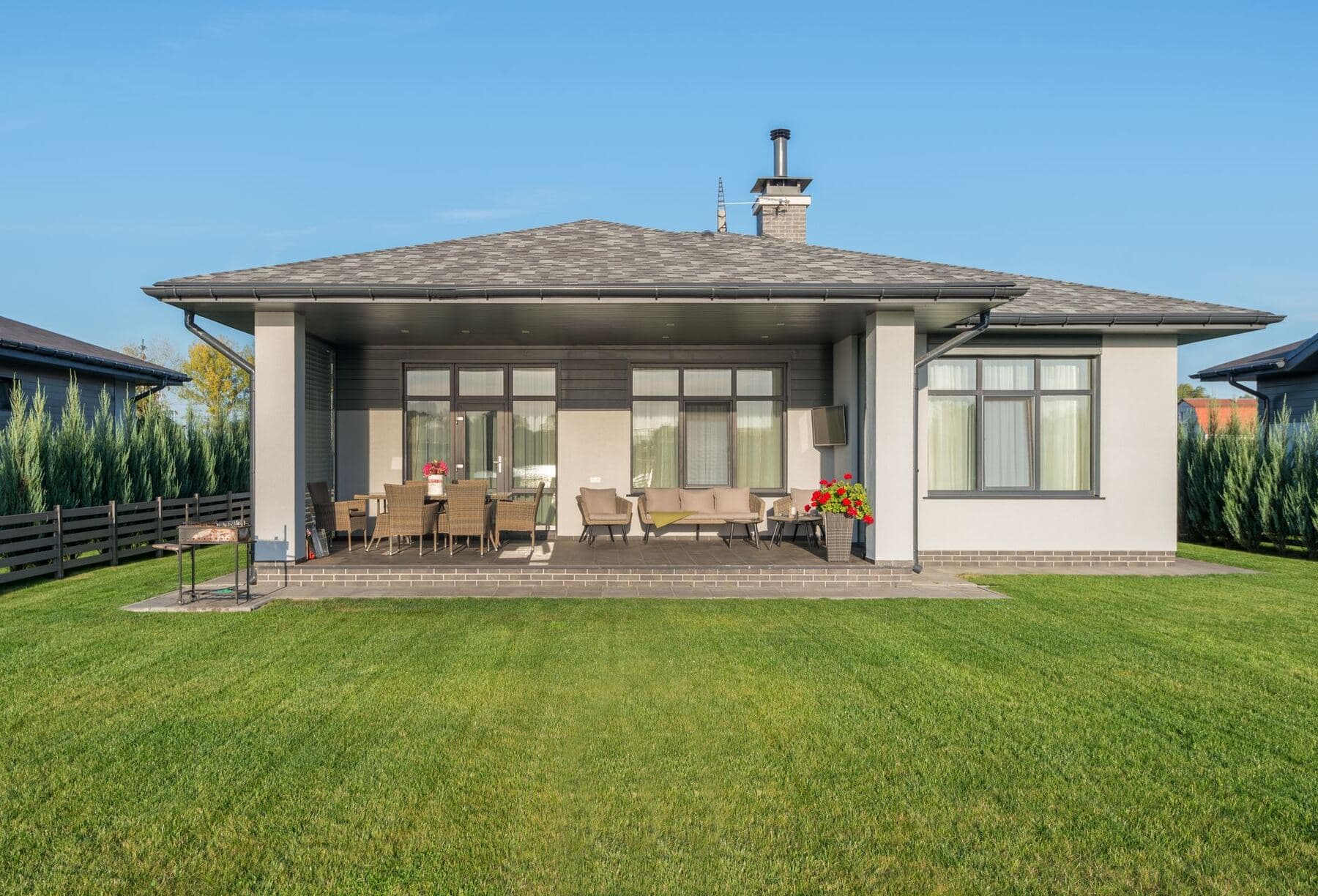
Concrete patio repair and resurfacing is one job in two stages. Cracks, spalls and pits are cut out and filled first, then a cement overlay 1.6 mm to 13 mm thick goes over the whole patio so the patches and the old surface finish as one. It works on a slab that is worn but still flat and stable. It does not work on a slab that has moved.
We repair and resurface concrete patios across Greater Victoria. HomeAdvisor puts resurfacing a concrete patio at $1,000 to $5,000, and the average cost of resurfacing a concrete patio at $4 per square foot. What decides whether you can have it is the kind of damage, not the budget, and the rest of this page is how to tell those two apart before anyone quotes you.
What repair and resurfacing actually puts on your patio
A resurfacer is a polymer-modified portland cement product spread over the slab you already own. The old concrete stays in the ground and keeps carrying the load. What you buy is a new wearing surface and a new finish, with no demolition, no disposal bin and no re-grading.
Repair comes first because the overlay is thin enough to telegraph anything left under it. The Quikrete Re-Cap Concrete Resurfacer data sheet, product No. 1131-47, is explicit that repairs to damaged concrete must be made before resurfacing can be initiated, that spalled and pitted surfaces are repaired with the same material mixed to a trowelable consistency, and that cracks must be widened, cleaned and filled before anything is spread over them. Skipping that sequence is the single most common reason a patio overlay looks wrong inside a season.
Side by side, straight off the data sheet
Below is the published data for one widely stocked resurfacer, assembled from the manufacturer's own sheet. Every timing figure carries the temperature it was measured at, because a cure time with no temperature attached is not a fact. Every row on this table comes from the Re-Cap Concrete Resurfacer sheet: applied from a feather edge of 1/16 in to 1/2 in, air and concrete surface temperature in the range of 50 to 90 degrees F, protect from rain for at least 8 hours, and section the work into areas no larger than about 144 sq ft.
| Published property | Quikrete Re-Cap Concrete Resurfacer, No. 1131-47 |
|---|---|
| Applied thickness | Feather edge to 1/2 in (1.6 mm to 13 mm) |
| Surface prep | 2500 PSI (17.2 MPa) pressure wash, called essential to a proper bond |
| Air and slab temperature | 50 °F (10 °C) to 90 °F (32 °C) |
| Working time | About 20 minutes at 73 °F (23 °C) |
| Foot traffic | 8 hours |
| Rain protection | At least 8 hours after placing |
| Moist curing | 24 to 48 hours before use |
| Placement sections | No larger than about 144 sq ft (13 m²) at a time |
Read the last row again, because it is the one that changes how a patio job is quoted. A typical Greater Victoria back patio is one continuous pour with a couple of control joints in it. The sheet wants the work broken at those joints into sections of roughly 144 sq ft, which means a 400 sq ft patio is three placements, not one, and the crew size has to match or the edges set before they are joined.
The claim everyone repeats that the sheet does not support
Search results will tell you resurfacing fixes cracks. The manufacturer will not. The same Re-Cap sheet says plainly that reflective cracking into the new surface cannot be completely prevented, especially if the slab does not contain adequate control joints or if slab settlement occurs, and that existing control joints and expansion joints must be maintained rather than covered over.
So the honest version is narrower. A filled crack under a fresh overlay is much less visible and no longer a trip point or a water path. It is not gone, and a slab that is still moving will show the line again. That is why we look at what the crack is doing before we talk about finishes. HomeAdvisor draws the same boundary from the cost side, noting that cracks wider than 1/8 of an inch could point to problems in the foundation's integrity, and that a structural engineer assesses the foundation for around $550. Above that width the question stops being a coatings question.
What actually eats a Victoria patio, and it is not freeze-thaw
Almost every patio-repair guide online blames freeze-thaw cycling and de-icing salt. Those guides are written for a continental climate, and on this island the numbers do not support the story. Environment and Climate Change Canada climate normals for VICTORIA INT'L A record 46 days a year with daily min temperature LE 0 deg C, but only 2.03 days a year with daily max temperature LE 0 deg C. A slab that thaws every single afternoon barely cycles at depth. Meanwhile the same station record shows 155.05 days a year with precipitation GE 0.2 mm.
That ratio is the whole local story. Water, not ice, is the agent here. A shaded coastal patio stays damp for most of the year, and persistent moisture is what lifts old sealers, feeds the algae and mildew the Re-Cap sheet names as bond contaminants that have to be removed before coating, and keeps a slab from ever reaching the saturated surface dry condition the overlay needs at placement.
It also sets the calendar. Against the 50 °F (10 °C) floor on the data sheet, the same Environment and Climate Change Canada normals put mean daily max temperature at 10.83 °C in March and 14.22 °C in October, with July and August carrying only 5.3 and 5.17 days of measurable precipitation. A patio overlay in Greater Victoria is a late-spring-to-early-autumn job, and the driest end of that window is where the 8 hour rain-protection requirement stops being a gamble.
What it costs and what moves the number
No fixed price is published here, because a patio is priced off condition and nobody can read condition from a search box. What is publishable is the third-party market range. Concrete Network reports that the costs of resurfacing are less than that of replacement, ranging between $3 and $10 per square foot. If you want a decorative finish rather than a plain grey one, Thumbtack's July 2026 guide puts decorative concrete overlays at $4 to $12 per square foot for a stamped pattern, and sealing the finished surface at $20 to $80 per gallon.
Inside those ranges, the things that actually move a patio number are: how much repair the slab needs before any overlay is mixed, how many placement sections the control joints force, whether the finish is a broom finish or a stamped and coloured one, how far the mixing station has to sit from the patio when a back yard has no vehicle access, and whether the weather window allows a second coat inside the 24 hour re-coat limit or forces the surface to be pressure washed again first.
So what does your patio need
Work down this list in order. The first line that describes your slab is your answer.
- Surface is worn, stained, pitted or lightly spalled, but flat and stable: this is a repair and overlay. The full process is on our concrete resurfacing page.
- Sections sit at different heights, or a crack has displacement across it: the slab has moved, and an overlay would be money spent twice. The same reasoning applied to a driveway is set out in driveway resurfacing or replacement.
- The surface in question is inside the garage rather than out the back, where moisture in the slab drives the decision: see garage floor epoxy.
- It is asphalt rather than concrete: none of the above applies and you are looking at driveway sealcoating instead.
- You are not sure which one you are looking at: book a site assessment and get told before anyone prices anything.
Estimates vary by property. Book a site assessment for a scope and price specific to your surface.
Sources
- Quikrete, Re-Cap Concrete Resurfacer product data sheet, product No. 1131-47, Division 32 / 03 92 00 revision.
- ASTM International, C1583/C1583M-20, Standard Test Method for Tensile Strength of Concrete Surfaces and the Bond Strength or Tensile Strength of Concrete Repair and Overlay Materials by Direct Tension, as listed under applicable standards on the Quikrete sheet above.
- Environment and Climate Change Canada, climate normals, VICTORIA INT'L A, climate identifier 1018620, annual values, 1981 to 2010 normals period.
- HomeAdvisor, concrete resurfacing cost guide, resurfacing a concrete patio at $1,000 to $5,000.
- Concrete Network, concrete patio cost, resurfacing ranging between $3 and $10 per square foot.
- Thumbtack, concrete resurfacing cost, decorative overlays at $4 to $12 per square foot for a stamped pattern, last updated 8 July 2026.